One word: classifieds.
By now, most people in the news business know that the collapse of classified revenue is the biggest financial threat newspapers face in the short term. But many fail to realize that not only were classifieds hugely profitable, classifieds were the only glue holding general-audience publications in one piece.
It's one of the many reasons why startups should generally not seek general audiences.
In media that face a scarcity of supply, like broadcast television or highway billboards, things are different. But the central goal of newspapers -- amassing a large general audience -- is profitable only because a classified section is a snowball: the bigger it gets, the faster it grows.
(Briefly, here's why. Obviously, every additional classified-section reader makes that section more valuable to advertisers. But because people who use a classified section want more than anything to maximize their selection of products, every additional classified ad makes the section more valuable to readers. It's a virtuous cycle.)
All this, I've understood for a while. Here's what I didn't grok until lately: the need to maximize the classified audience used to be a huge centripetal force on news content, pulling coverage toward the center of public life, toward the things everyone shared. The publisher's objective: maximize the audience. The editor's marching orders: please everyone in town a little bit.
Meanwhile, there was an opposing, centrifugal force: display advertising. Unlike classified advertisers, most businesses are looking for narrow demographics. They don't want to pay for a big display that everyone will see. They want to pay for a cheaper display that only the right people will see. The narrower your audience, the less of your marketing budget that you're wasting.
So: retail ads would seek diversified audiences, classified ads would seek general audiences -- and for a while, classifieds would win.
Then the sea change.
These days, newspapers aren't scarce; a printing press comes free with every Internet connection. For a few years, even the lure of free classifieds on Craigslist couldn't offset the value of the big audience offered by a newspaper. But one by one, advertisers slipped toward the free service, and the classifieds audience has followed. A tipping point came in 2007, when Craigslist's growing audience (and that of other listings sites) got big enough to be really valuable.
More or less, this is why the crisis is happening now.
Today, retailers are still looking for niches. Retail advertisers want to push newspapers and other audience-generating businesses away from the center of public life, into all the demographic nooks and crannies.
And today, there are no classifieds to pull us back.
Tuesday, March 31, 2009
Why the general audience exists

Wednesday, March 11, 2009
Old forest, new trees
If you stand far enough back, the future of local news is so easy to see at this point that you can practically phone in your story and still sum things up well.
That's exactly what Perez-Pena does today. He quotes the right people, including Jeff Jarvis, who has the emerging conventional wisdom:
The death of a newspaper should result in an explosion of much smaller news sources online, producing at least as much coverage as the paper did, says Jeff Jarvis, director of interactive journalism at the City University of New York’s graduate journalism school. Those sources might be less polished, Mr. Jarvis said, but they would be competitive.
That's where things are going, and that's where this blog is going, too.
Wednesday, February 04, 2009
Two things about the Seattle Courant
1) I wish them well, and you should, too.
2) ...but note the comma splice on their "about" page.
Saturday, January 10, 2009
Letter to a(nother) young reporter
In the two years I've been playing hooky from the blog -- late '06 to early '09 -- many outlets have launched exciting new lifeboats, most of which have been or are about to be sucked under by the Titanic that's about to submerge behind them.
The latest fad seems to be a call for papers to shun their still-unprofitable Web sites and turn to the real business at hand: harvesting ever-shrinking profit from the print product.
That's fine: if newspapers don't need us, we don't need them. Which was basically my argument in the following letter to an aspiring reporter. Among my claims:
1) Young journalists should generally not seek work at any general-audience outlet that is older than the Web browser.
2) Yes, that includes small markets.
3) The brightest up-and-comers are Web startups that cater to smaller, more highly motivated audiences.
4) For a newcomer, the likeliest path to a job at one of these startups wouldn't be demonstrated expertise in writing -- it'd be demonstrated expertise in the subject matter.
Full letter follows.
Hi, Patricia-
GA-THUMP! I'm going to load you with more information than you need on a quiet Saturday morning.
First off, I'm a government reporter. I occasionally get to dabble in various sorts of artsier culture coverage, but mostly I'm interested in policy, and that's what I write about. But most of my reporting colleagues -- features, sports, business -- got here in more or less the same way.
Starting with the stuff about my own career: I worked four years at the main student paper where Anna and I went to college, including one summer internship at a free alt-weekly paper in my hometown. When I graduated with an English degree in 1999, this wasn't enough to get me in the door at a small-town daily paper, so my first job out of college was at a twice-weekly in rural Iowa. Then I took out $35,000 in loans to do grad school at Northwestern, whose j-school has a pretty good name. My best classes there were the semester I spent in D.C., covering Congress for the Tuscaloosa News (sort of a pseudo-internship) and a semester I spent writing the business plan for a prototype weekly paper for young adults in suburban Chicago.
This got me a job running the Web site at the Longview Daily News, a small-town paper in Washington, and after a year there I moved to a suburban daily outside Portland. I've been at the Columbian for two years now. I'm 27. I make $15.97 per hour, 40 hours a week, $33,500 a year; I rent a one-bedroom apartment in a nice neighborhood for $595; I shop at Safeway, own a '99 Toyota, rarely fly, save 10 percent for retirement and cook for myself five or six nights a week. I'm comfortable.
I love the freedom and independence of my job, which requires a good mix of artistry and technical knowhow. I like being able to play with different forms and I like learning something new almost every day. I like being responsible more to my readers and my community than to my company. I like having the respect of important people.
I file about four stories a week, 600 to 800 words each. I do four or five major projects (1,500-2,000 words) per year.
Like many newspapers, mine is dancing back and forth from the edge of bankruptcy and the bosses have no long-term plan to save it.
For the last 30 years, this was a fairly typical trajectory for daily newspaper journalists, both feature writers and news reporters: spend a few years in the boonies, working overtime until you collected a portfolio of good clips. Using these, and using contacts among your colleagues and competitors, you climbed your way up to bigger markets, which offered better pay, less quantity, more quality and more specialization.
Describing the journalism market right now is a tall order, so I'm going to depart from your template to do so.
Local newspapers have traditionally been the biggest employers of journalists, with the biggest audiences and the most influence. (National outlets aside.) And as I assume you've heard, newspapers are in big, big trouble. Eighty percent of our revenue comes from ads, but with a shrinking audience, ads in newspapers are becoming less valuable. The audience is shrinking because the Internet provides broader and deeper information than our print product ever can, and our online product is basically just an electronic version of the print product, so it's not going to save us, either.
The economy is making things worse, but this is a permanent situation. Buffett said that until the tide goes out, you don't see who's been swimming naked, and newspapers have been swimming naked for about a decade.
Local TV news, another big journalist employer, is in the same situation. Network TV audiences are shrinking just as fast, and their Web sites aren't any more innovative than newspapers'.
All this is to say that in case you were thinking about it, I would not recommend trying to break into general-audience outlets like newspapers or television. A smart newcomer could almost certainly find a job for a non-daily newspaper in a small town, but it'd almost certainly be a dead end.
Many people break into journalism by freelancing for local or niche magazines. General-interest magazines are also in trouble, but niches are doing better. Business newspapers and trade publications (like American Cop or Architectural Digest) also seem to be doing fine.
Freelancing requires some other source of income as you start, but it might be the best way to tap that artsier energy you mention. To start doing this, look on the Web site of a small publication you like (print or online) to find out if they pay for freelance pieces. If so, cold-call (or, better, walk into) their office and ask for advice on how and what to submit. Start with short stuff, and move to longer projects.
The up-and-comers, journalistically, are Web startups that cater to smaller, more highly motivated audiences (like, say, streetsblog.org). Right now, I'm looking for a job that'll let me do this for municipal policy, hopefully at a state or local level. It's hard to find, not least because of the thousands of laid-off newspaper journalists flooding the market.
I'd tell you more about those startups -- who they tend to hire, how they pay, what skills they require -- but I don't know and in any case I don't think the rules have been written. I think personal contact is very important for small companies like these, I don't think traditional journalism classes would do a very good job of preparing someone for this work and I don't think these companies would tend to care about what classes you've taken.
I suspect that for a newcomer, the likeliest path to a job at one of these startups wouldn't be demonstrated expertise in writing -- it'd be demonstrated expertise in the subject matter. And I think the best way to demonstrate expertise on a topic is to launch a blog about it and post to it consistently over several months, whether or not it attracts a substantial audience.
That's just my hunch. I hope it (and at least a bit of the above) helps. Let me know if you have any other questions (if you dare).
Michael
The Medium Run rebooted
Changes:
1) The subtitle: "local newspapers" -> "local journalism"
2) The goal: local newspapers -> local journalism
3) The sidebar: fresh blogroll, less noise from Delicious
Promises:
0)
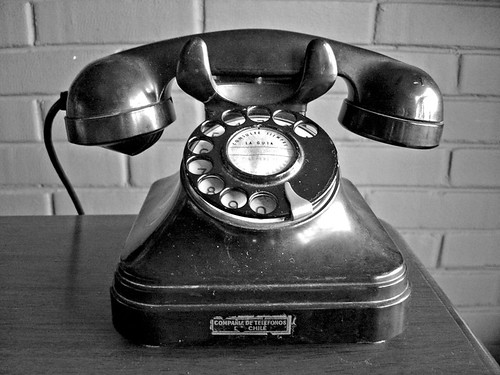
BRRRING!
I danno, boss. Thing been sitting right next to me all year, never rang once.
(photo courtesy Flickr user storm_gal)
Tuesday, August 14, 2007
The logical conclusion of Newspaper Next
The surprising implication of the very persuasive Newspaper Next presentation I sat through today: Screw newspapers. If newspapers don't need us, we don't need them.
Need I add that I'm not talking about the short run here?
No jump on this one. More about this in a later post, maybe.


 Other feed options
